Students taking part in the project meeting wrote up guidelines for interreligious dialogue which they will implement at their schools. Here you can read our guidelines in four languages:
Showing posts with label progress. Show all posts
Showing posts with label progress. Show all posts
Monday, 26 November 2018

Saturday, 6 October 2018
Managing Diversity Strategies for Schools
After the international project meeting in Dolni chiflik, Bulgaria the students wrote their own managing diversity strategies which we proudly publish today.
Sunday, 17 December 2017
Conflicts caused by diversity
The German students met this week to discuss the conflicts they have collected and find out the reasons behind them. They are now working on an English translation and doing more research.


Thursday, 7 September 2017
Publication of our ebook "History of Migration. Bulgaria - Germany - Romania"
The beginning of the new school year sees the publication of our joint ebook "History of Migration. Bulgaria - Germany - Romania" which collects some of project results. We wanted to look at European history of migration not from just one perspective but all three at the same time. During the process we were suprised more than once. We hope that you enjoy reading our ebook:
https://issuu.com/mrshansen/docs/history_of_migration
https://issuu.com/mrshansen/docs/history_of_migration
Friday, 16 June 2017
Interview for project “Becoming a multicultural European” - Radio “Fokus”

Interview
for project “Becoming a multicultural European” - Radio “Fokus”
Four teachers and nine students from Secondary school “Vasil Levski”, Dolni chiflik took part in the Second transnational project meeting on Erasmus+, part of “Becoming a multicultural European” project. It was announced for Focus radio Varna from Minicipality of Dolni chiflik. The meeting was held in the beginning of May at “Nichita Stanescu” school, Bucharest, Romania. The main topic of all project activities was “History of migration”.
“Becoming a multicultural European” project pointed young people`s attention on variety, intercultural and interreligious dialogue and has an aim show Europe as a chance. During the project activities in the Romania capital problems of European migration in the past and nowadays were surveyed and discussed. Students made researches among migration between partner countries – Bulgaria, Romania and Germany and collected information will be published in a ebook.
Secondary school “Vasil Levski”, Dolni chiflik earned financing last year for work on a project of strategic partnership on KA 2 of Erasmus+ programme for education, culture and youth of European commission. For 2 years the school is going to be part of “Becoming a multicultural European” project and is partnering with schools from Hagen, Germany and Bucharest, Romania. Each of the educational institutions has a budget to realize the scheduled activities with students and takes part in cross-border meetings on the project. Secondary school “Vasil Levski” is the only one in municipality of Dolni chiflik and one of four schools from Varna region approved for funding under this programme scheme for 2016. The duration of the project is 26 mounts and it aims to improve school competence in managing of the diversity, intercultural and interreligious dialogue and to encourage students to see Europe as a chance. The first project meeting at the end of last year was in Hagen, Germany.

Wednesday, 23 November 2016
Project meeting day 3

Today the students and teachers took part in transcultural training sessions to find out more about the fact that everyone perceives the world in a different way - with different cultures as a background. Culture in this context is a very open concept which can mean a variety of things. Transcultural trainer Jamin Marla was a great expert and teacher to show us how we can become more open-minded about other people and look for similarities rather than things which are different.

We would also like to share a video of a TED talk in which Chimanda Adichie explains how a "single story", i.e. a reduced view, leads to stereotypes:
Teachers also investigated the web 2.0 tools on the market in order to decide which ones they want to use during the project. After a very inspiring day the students went to spend a day at a German host family and teachers went into town or to see some sights in Hagen.




Tuesday, 22 November 2016
Project meeting day 2
The second day of our project meeting started with some scientific input: "An introduction into migrational studies on the example of migration flows from Romania and Bulgaria to Germany" by lecturer Ines Gottschalk from Ruhr Universität Bochum. In her excellent presentation she gave 4 ideal types of migrants and their motives, continued to explain research methods such as discourse analysis, quantitative and qualitative research and gave some results on her research. This was perceived as very inspiring for our project.

Next students and teachers sat together and made detailed plans of the topics which they are responsible for and discussed this afterwards.


In the afternoon we visited one of Hagen's "best bunkers" from the second world war and took part in the simulation of a bomb attack. Everybody thought that this was a worthwhile experience.


The students are getting on well together and sat down for a meal at lunchtime.

Monday, 21 November 2016
Project meeting day 1
Kaufmannsschule II welcomed the Bulgarian and Romanian delegations today in Hagen. Headteacher Thomas Vogl gave a welcoming speech to the teachers and students visiting the school. After the students presented their schools and cities teachers were shown round the school and students took part in lessons. Everybody was very interested in meeting the lovely open-minded people. The ideas of the project were summarised for the participants and the students were introduced to the whole project.

The afternoon was spent exploring Hagen and its signs of migration. Luckily we could walk around the Christmas market, too.
Some results of the day:


The afternoon was spent exploring Hagen and its signs of migration. Luckily we could walk around the Christmas market, too.
Some results of the day:


Saturday, 1 October 2016
Official start of KA2-project
We're back on this blog! Hooray! We have enjoyed working on the topic of diversity to much that we have applied for EU funds for a KA2-project for some time. This year we were lucky and received funds to work on the project. We are so happy! Now, who is we?
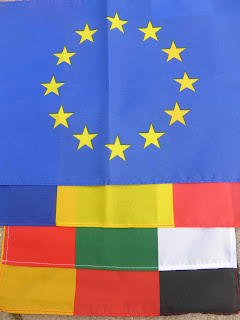
It's three schools who have been working on all the eTwinning-projects we did:
The project combines virtual learning and communication with personal experience at transnational project meetings. The three applying schools have a wealth of experience in international projects using the eTwinning platform. Staff and pupils at the schools meet people of different cultural and religious backgrounds both at school and in their freetime. There has been migration between the three countries of Bulgaria, Germany and Romania and recently the debate about migration from Romanians and Bulgarians to Germany has triggered many stereotypes. We believe that misconceptions about other nations and cultures can only be overcome by communication and interaction. Thus the project focuses on virtual communication and interaction as well as transnational project meetings.
One of the objectives is to find ways of encouraging students to meet of different cultures and to overcome common prejudices though working on the same project and doing assignments in international group work. At the same time this will be supported by face-to-face meetings which cannot completely be replaced by virtual interaction. The consortium will survey students on the conception of other nations before the project, during international group work and after transnational project meetings to find out if communication, interaction and personal meetings have an influence on their opinions.
The project will start with a meeting at the coordinating school in Hagen which will focus on organisational issues and train staff to carry out the project efficiently (e.g. intercultural training, successful blogging, using eTwinning, scientific input on migration). Pupils will be involved in order to work as multipliers for the project at each school. The teachers will be members of the project team and the pupils will be chosen among those interested.
The next project step will be the investigation of migration involving the three countries, approaches will include historical research, interpretation of statistics and interviewing people with a migrational background. Students will learn how to present their findings in a virtual classroom. These acitvities will lead to the project meeting in Romania at which the ebook "History of Migration: The cases of Bulgaria, Romania and Germany" will be presented to the public.
The next project step looks at the current situation and students' feelings towards each other (results from the surveys) and focuses on multicultural concepts and issues. The focus is on the development of a strategy of managing multiculturality at all schools - staff and students defining general needs and special content for each school. These strategies will be presented at the transnational project meeting in Bulgaria which will also identify steps for implementing those strategies.
The last project step is devoted to religion as the political situation at the moment calls for interreligious dialogue in order to make students strong against extremist views. We believe that if you know facts and believers you are less likely to develop hostile attitudes against a different religion. This leads to the last project meeting in Hagen in the Ruhr area which is a melting pot regarding religions. We also want to look at the role the EU plays in the area of multicultural policies and plan to visit Brussels to get first-hand experience.
Last but not least we hope to influence our students and staff to be open-minded concerning multicultural settings and enable students to work in international environments using ICT.

It's three schools who have been working on all the eTwinning-projects we did:
- Liceul Teoretic Nichita Stanescu, Bukarest, Romania
- General secondary school Vasil Levski, Dolni chiflik, Bulgaria
- Kaufmannsschule II, Hagen, Germany.
The project combines virtual learning and communication with personal experience at transnational project meetings. The three applying schools have a wealth of experience in international projects using the eTwinning platform. Staff and pupils at the schools meet people of different cultural and religious backgrounds both at school and in their freetime. There has been migration between the three countries of Bulgaria, Germany and Romania and recently the debate about migration from Romanians and Bulgarians to Germany has triggered many stereotypes. We believe that misconceptions about other nations and cultures can only be overcome by communication and interaction. Thus the project focuses on virtual communication and interaction as well as transnational project meetings.
One of the objectives is to find ways of encouraging students to meet of different cultures and to overcome common prejudices though working on the same project and doing assignments in international group work. At the same time this will be supported by face-to-face meetings which cannot completely be replaced by virtual interaction. The consortium will survey students on the conception of other nations before the project, during international group work and after transnational project meetings to find out if communication, interaction and personal meetings have an influence on their opinions.
The project will start with a meeting at the coordinating school in Hagen which will focus on organisational issues and train staff to carry out the project efficiently (e.g. intercultural training, successful blogging, using eTwinning, scientific input on migration). Pupils will be involved in order to work as multipliers for the project at each school. The teachers will be members of the project team and the pupils will be chosen among those interested.
The next project step will be the investigation of migration involving the three countries, approaches will include historical research, interpretation of statistics and interviewing people with a migrational background. Students will learn how to present their findings in a virtual classroom. These acitvities will lead to the project meeting in Romania at which the ebook "History of Migration: The cases of Bulgaria, Romania and Germany" will be presented to the public.
The next project step looks at the current situation and students' feelings towards each other (results from the surveys) and focuses on multicultural concepts and issues. The focus is on the development of a strategy of managing multiculturality at all schools - staff and students defining general needs and special content for each school. These strategies will be presented at the transnational project meeting in Bulgaria which will also identify steps for implementing those strategies.
The last project step is devoted to religion as the political situation at the moment calls for interreligious dialogue in order to make students strong against extremist views. We believe that if you know facts and believers you are less likely to develop hostile attitudes against a different religion. This leads to the last project meeting in Hagen in the Ruhr area which is a melting pot regarding religions. We also want to look at the role the EU plays in the area of multicultural policies and plan to visit Brussels to get first-hand experience.
Last but not least we hope to influence our students and staff to be open-minded concerning multicultural settings and enable students to work in international environments using ICT.
Subscribe to:
Posts (Atom)